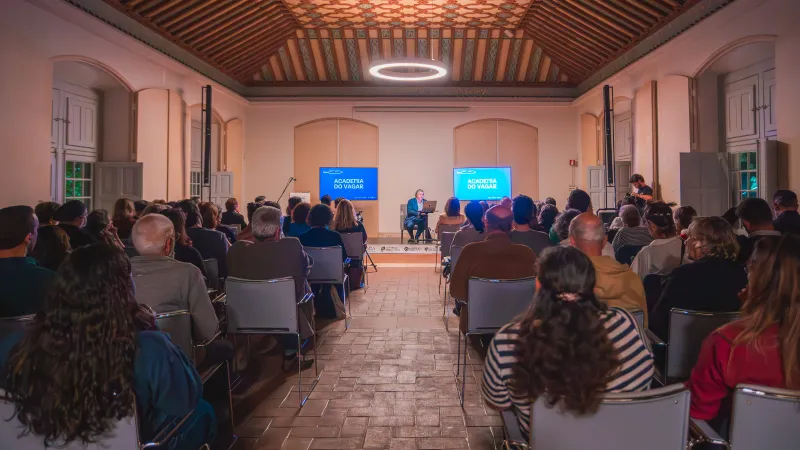
The Academia do Vagar is a monthly programme of lectures, gatherings and workshops, curated by Jacinto Lageira, Professor at Paris 1 Panthéon-Sorbonne University.
This conference is not an analytical study, but rather a first-hand account rooted in many years of geopoetic practice, writing and cultural projects - such as the original 2020 concept, The Traveling Light, which later evolved into a project within Évora_27.
Geography is perilous because it does not lie. Geography sets us free. It invites us to explore, discover and build a stronger bond - a more cohesive fabric - with what surrounds us. It is a continuous, uninterrupted fabric on which we can read the marks of evolution.
Geography works as a book of the world, teaching us the importance of remembering that landscape is, above all, a matter of perception. Indeed, many of the choices made by contemporary society are based on perception - choices that are not merely aesthetic, but profoundly emotional, philosophical and existential.
Through a personal geopoetic practice, perceptions - those moments of illumination - can dispel the fears and aggressive impulses that we might otherwise project onto the earth (geography - from the Greek geographia: 'description and representation of the Earth'), in the form of occupation, neglect, environmental aggression and over-exploitation.
Geography is the planet's oldest form of writing: a language taught to us by the earth itself - a language so universal that living beings have 'used' it since the dawn of time. Rivers, mountains, plains, capes, valleys, plateaux, gorges and deserts are interconnected just as nouns, verbs, adjectives, conjunctions and adverbs are combined to express emotions, thoughts, ideas and theories, thereby articulating new narratives made up of stories, discoveries and questions.
Davide S. Sapienza
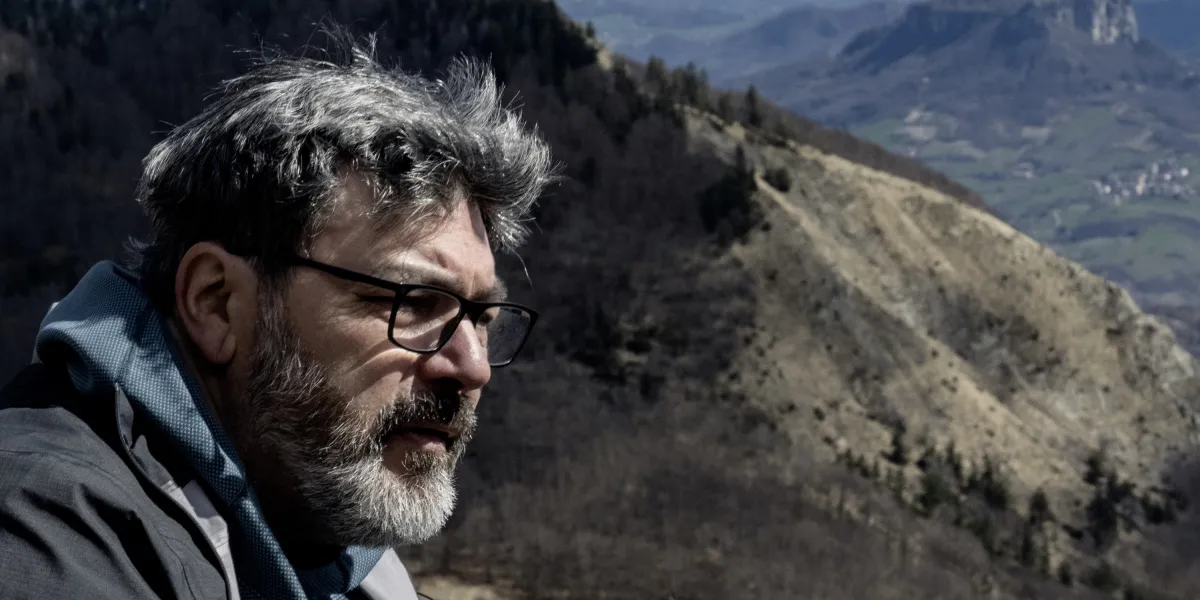
A writer, author of reportage, podcasts and documentaries, translator and editor of modern and contemporary classics — including the works of Jack London, on whom he is an internationally recognised independent scholar, and those of his late mentor and friend Barry Lopez — he is a pioneer of literary walking as an established and ongoing geopoetic practice.
He weaves together storytelling, narratives and reflections to foster a distinctive understanding of landscape and its relationship with human experience. His poetic vision approaches every word with respect for its intrinsic “biodiversity”. Recognised as one of Italy’s leading authors writing about nature, ecological commitment, spiritual connection and a deeper understanding of our place in the world, he was among the first to introduce literary walking as a form of “geopoetic” practice — working with Italian and international associations and institutions, including libraries and parks — and as a way of interpreting the landscape through a poetic perspective.
His books include I diari di Rubha Hunish, La musica della neve, Scrivere la natura, Camminando and Nelle tracce del lupo. In 2025, he published an expanded and revised edition of his seminal work Geopoeta, nelle terre della percezione (Meltemi Editore), which also inspired a four-part podcast series of the same name.
Walking is at the heart of his cultural projects, including In The Garden Of Arctic, for the Nordland National Park Center and Bodø 2024 – European Capital of Culture, in the Arctic Circle; Rocklines (UNESCO Minett Biosphere Reserve); Ages of Mellerdall (UNESCO Mellerdall Geopark); The Traveling Light (Évora_27); and, for the Italian forestry agency ERSAF, La via dei silter (2014), in collaboration with Franco Michieli.
As an author and storyteller, in collaboration with Lorenzo Pavolini, he created Nelle Tracce Del Lupo and Ghiaccio Sottile, two acclaimed original podcasts for RaiPlay Sound. In 2025, together with Damiano Grasselli (Teatro Caverna), he produced the podcast series Uomini e montagne for Orobie magazine.
He regularly gives talks and leads geopoetic walks in schools, at conferences and as part of training programmes.
Since 1984, he has written, translated or edited more than fifty volumes.